UKAS Accredited Coliform & E. coli Analysis

Guaranteed Technical Competence
Our UKAS accreditation to the ISO/IEC 17025 standard is your assurance of technically valid results, competence of staff, and the reliability of our methods.

Regulatory Compliance
Focus
Our services are specifically designed to help you meet your legal duties under the HSE’s ACoP L8 and HSG274 guidelines, ensuring you are fully compliant.

Clear, Actionable
Reporting
We provide more than just data. You receive a comprehensive certificate of analysis with jargon-free interpretation to help you understand your results and take the right actions.

Legally Defensible
Results
Using a UKAS accredited laboratory provides a robust audit trail and demonstrates due diligence, giving you peace of mind in the event of regulatory scrutiny.
What are Coliforms and E. coli?
Coliforms and E. coli are types of bacteria known as ‘indicator organisms’.
Their presence in a water sample is used to indicate whether the water may be contaminated with more harmful, disease-causing pathogens.
While most coliforms are harmless and found widely in the environment, the presence of E. coli specifically points towards recent faecal contamination from humans or animals, posing a significant risk to health.
The Significance of Indicator Bacteria in Water Safety
Testing for these indicator bacteria is a fundamental part of ensuring water is safe for consumption and use.
Identifying Contamination:
The presence of coliforms suggests that the integrity of the water system has been compromised, allowing environmental contaminants like soil or surface water to enter.
Detecting Faecal Pollution:
A positive result for E. coli is a serious issue. It strongly indicates that the water has been contaminated with sewage or animal waste, which can carry dangerous pathogens like Salmonella and viruses.
Meeting Legal Standards:
For drinking water in the UK, the legal standard for both E. coli and Enterococci is zero per 100ml. Any detection constitutes a failure and requires immediate action.
Who Requires This Analysis?
Regular testing for coliforms and E. coli is essential for a wide range of clients and systems to ensure public health and regulatory compliance. This includes:
Private Water Supplies:
Owners of wells, boreholes, and springs are legally required to ensure their water is safe and must test regularly.
Commercial, Healthcare & Public Buildings:
Offices, hotels, hospitals, care homes and retail spaces must provide wholesome drinking water for staff and visitors.
Food & Beverage Industry:
Businesses involved in food production require high-quality water free from contamination to ensure product safety.
Recreational Waters:
Swimming pools and spa pools are tested to ensure they are free from faecal contamination.
Our UKAS Accredited Testing Process
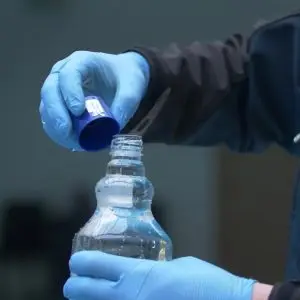
Step 1: Sample Delivered to Us
A water sample is delivered to our lab from one of our clients in a sterile bottle. This process should follow strict procedures to prevent any external contamination.

Laboratory Analysis
In our UKAS accredited laboratory, the sample is analysed using the membrane filtration method. The water is passed through a filter that traps bacteria, which is then placed on a selective culture medium and incubated.

Identification & Reporting
After incubation, our microbiologists identify and count any coliform and E. coli colonies. You receive a clear certificate of analysis detailing the exact count (in cfu/100ml) and confirming whether the water meets UK safety standards.
Frequently Asked Questions
Q: What is the difference between Total Coliforms and E. coli?
A: Total Coliforms are a broad group of bacteria found widely in the environment, in soil, and on plants. E. coli is a specific sub-group of coliforms that is found almost exclusively in the gut of humans and animals. Its presence is a direct indicator of faecal contamination.
Q: What happens if my water test is positive for E. coli?
A: A positive E. coli result means the water is not safe to drink. The local authority is likely to serve a notice requiring you to take immediate action, such as boiling all water for consumption, while the source of the contamination is investigated and rectified.
Q: If only coliforms are found, is the water still safe?
A: While not as serious as finding E. coli, the presence of coliforms indicates a problem with your water system (e.g., surface water getting into a well, or a dirty storage tank). It means the system is vulnerable to contamination, and remedial action is strongly recommended.